
A Popular interview question set is Mision, Vision and Strategy differences and techniques to create these. This article is a comprehensive playbook for Product Leaders to achieve mastery.
It was 2006. I was hired at Merrill Lynch as a Development Manager to build a client onboarding system in the Reference Data department. I had authority over both the team and the architectural decisions. Three months before I arrived, business and technology leadership had shaken hands on a deal: deliver this product in three months. When I got there, not one line of code had been written.
The Business Stakeholders were furious. The relationship between the two sides had deteriorated badly enough that they brought in an outside consulting firm just to get both sides talking again.
The consultants did the right thing. Before anyone touched a backlog or a sprint plan, they called a session to align on three things: what is the mission of this department, what is the vision for the product, and what is the strategy to get there.
Two weeks in, the room was still stuck. People were using mission and vision interchangeably. Strategy was getting confused with vision. Nobody wanted to admit they didn’t know the difference because everyone in that room had a title that suggested they should. The one thing they struggled the most with was strategy. How do we realize our goals given we haven’t delivered anything at all. What guarantee is there that we will be able to deliver anything in the next three months.
With about 15 years of delivery experience at that time, this is where I stepped in.We stopped debating the perfect destination and started planning interim deliverables by month. We would no longer wait for the big picture to get clear but focus on intermediate milestones as a strategy to build trust, while the leadership continued to focus on the Mission and Vision.
It worked. Every month there were deliverables that the stakeholders were able to visualize the solution and provide feedback. They were not releasable to the end customer but because we delivered interim value the big picture became clear.
But it cost us weeks and many high paid consultants to build our Mission and Vision. And I’ve watched the same thing happen in boardrooms of small, medium and large organizations.
Mission is why you exist, Vision is the North Star and Strategy is how you get there
When you interview you should be intimately familiar with all three and how you can help your team create it.
Mission: Why You Exist
Mission is present tense. It doesn’t change when the market shifts or a competitor launches. It answers one question: why does this organization or product team exist?
A strong mission is a filter, not a slogan. Every product decision, partnership, and prioritization call should run through it.
Examples worth studying
Nike: To bring inspiration and innovation to every athlete in the world. Then they added the footnote that became iconic: if you have a body, you are an athlete. That single addition tripled their addressable market without changing a word of the core mission.
Patagonia: We’re in business to save our home planet. Eight words. No ambiguity about what matters and what gets cut.
LinkedIn: To connect the world’s professionals to make them more productive and successful. Specific enough to make decisions with, broad enough to grow into.
Notice what all three have in common. None of them mention a product feature. None mention revenue. They describe the change they exist to create in someone’s life.
At Merrill Lynch, the department couldn’t articulate why they existed beyond “we process client accounts.” That’s a function, not a mission. Functions get cut. Missions get funded.
So how to write yours?
The “So That” Technique
Start with what your team does and keep adding “so that” until you hit something that matters to a human being.
“We build onboarding software… so that new advisors can set up client accounts… so that advisors spend their first week advising instead of wrestling with paperwork… so that clients get better financial guidance from day one.”
That last statement is your mission candidate.
The “So That” Technique This is rooted in Simon Sinek’s “Start With Why” framework. The primary source is his book “Start With Why” (2009) and his original 2009 TED Talk “How Great Leaders Inspire Action” still one of the most watched TED Talks ever. Both are accessible and practical for a product leader audience.
The Disappearance Test
Ask your team: if our product disappeared tomorrow, who would feel it most and what exactly would they lose? The answer points directly at your mission.
The Disappearance Test This comes from brand strategy work. The clearest written treatment is in Marty Neumeier’s “The Brand Gap” (2003) and “Zag” (2007). Both are short reads and directly applicable to product teams thinking about differentiation.
The Customer Job Test (from Jobs-to-Be-Done)
What job is your customer hiring your product to do? Not the feature, the underlying human need. Frame your mission around that job.
The Customer Job Test (Jobs-to-Be-Done) The foundational text is Clayton Christensen’s “The Innovator’s Solution” (2003). For a more hands-on facilitation guide, Anthony Ulwick’s “Jobs to Be Done: Theory to Practice” (2016) is the practitioner’s version. Ulwick’s website at strategyn.com also has free facilitation guides.
A good mission should pass one final check: can a new team member read it and immediately understand what to say yes to and what to say no to? If it’s vague enough to justify anything, it’s not doing its job.
Interested in an hands on course to learn how to facilitate creating a mission? Join my live online or in person Scrum Alliance Advanced Certified Scrum Product Owner
Vision: Where You’re Going
As a child did you ever imagine what you wanted to be when you grow up? I wanted to be a super hero. Over time that changed. As it changed, the plan on how to get there also became apparent. What you wanted to be when you grow up is the Vision and how you get there is the Strategy.
Vision is future tense. It paints a specific picture of what success looks like when the mission is fully realized. If your vision sounds like your mission, you haven’t gone far enough.
Vision is not a revenue target, a product roadmap, or a list of features. Those are outputs. Vision is the destination or outcomes that makes those outputs meaningful.
Examples worth studying
Nike: To remain the most authentic, connected, and distinctive brand in the world. Directional, competitive, and clear about the standard being chased.
IKEA: To create a better everyday life for the many people. Simple language, massive ambition. It keeps a furniture company thinking about human wellbeing, not just sofas.
Spotify: To unlock the potential of human creativity by giving a million creative artists the opportunity to live off their art. They are in the creative economy business. That vision explains every strategic move they’ve made in podcasting, audiobooks, and artist tools.
In the Merrill Lynch engagement, the technology team had a vision for what the onboarding system would do technically. The business team had a vision for what the client experience would feel like. They were describing two different futures.
So how do you write yours?
The Headline Technique
Ask your team: if a respected industry publication wrote a story about your product five years from now, what would the headline say? Push past the generic.
“Company Grows Revenue” is not a headline. “The Platform That Gave Every New Financial Advisor ability to grow” is.
Widely used in design thinking facilitation. IDEO’s Design Thinking Field Guide covers it, available free at designkit.org. Also referenced in Jake Knapp’s “Sprint” (2016) as part of the long-term goal exercise on day one of a design sprint.
The From/To Exercise
Map your customer’s current experience against the ideal future state. The gap between those two is your vision territory.
Current state: New financial advisors spend their first two weeks drowning in paperwork, missing client calls, and second-guessing every process.
Future state: A new advisor completes onboarding in 48 hours, walks into their first client meeting confident, and spends their energy on relationships instead of administration.
The From/To Exercise John Kotter’s “Leading Change” (1996) is the source most product leaders will recognize. The From/To mapping is also covered in depth in Esther Derby and Diana Larsen’s “Agile Retrospectives” (2006) for teams who want a facilitation script for running it with their teams.
The Press Release Exercise (used internally at Amazon)
Write a fake press release announcing the product as if it has already achieved its vision. Force yourself to describe the customer impact in concrete terms. If you can’t write the press release, your vision isn’t clear yet.
The Press Release Exercise (Amazon Working Backwards) The definitive source is Colin Bryar and Bill Carr’s “Working Backwards: Insights, Stories, and Secrets from Inside Amazon” (2021). Chapter three walks through exactly how Amazon runs the exercise internally. Ian McAllister, a former Amazon GM, also published the original public description
Vision should be specific enough to be directional and ambitious enough to require strategy to reach. If you can achieve it without changing anything about how you currently work, it’s not a vision. It’s a goal.
Strategy: How You Close the Gap
Strategy is the bridge between mission and vision. It describes the high-level approach you will take to move from where you are to where you’re going. This is the one element that should change as conditions change. Mission and vision are anchors. Strategy is the direction from the GPS.
Strategy is not a roadmap. A roadmap is a sequence of decisions. Strategy is the reasoning behind why you’re making those decisions in that order.
Examples worth studying
Nike: Shifted to direct-to-consumer sales and pulled products from major third-party retailers. Controversial at the time. Strategically it gave them control over pricing, brand experience, and customer data. Mission and vision stayed constant. The approach to achieving them changed completely.
Starbucks: Built their early growth strategy around the “third place” concept: not home, not work, but a place people want to linger. That single strategic idea drove store design, music, WiFi policy, and even cup sizes. It was a lens for every decision.
Netflix: Started as DVD-by-mail, shifted to streaming, then shifted again to original content production now experimenting with producing original gaming from their successful shows. Completely different strategies in service of one consistent vision. Each strategic shift was a response to where the obstacles were, not a change in destination.
At Merrill Lynch, the breakthrough came when we reframed strategy from “build everything by month three” to “deliver working software every month so business sees progress and technology builds credibility.” That was a strategic choice. It changed the relationship between the two sides more than any definition session could.
How to write yours
The 3Cs Framework (Kenichi Ohmae)
Before you write a single strategic statement, you need to understand the three forces that shape every strategy worth building.
Customers
Who are you serving and what do they actually need? What problem are they hiring your product to solve that they can’t solve well today? Strategy built without deep customer understanding is guesswork dressed up as planning.
Nike asked: what does an athlete need to perform at their best and feel connected to the sport they love? That question drove everything from product design to their app to community running events.
For your product team: which customer segment has the most urgent unmet need? Which segment, if you served them brilliantly, would pull all other segments toward you?
Competitors
Where are they strong and where are they exposed? What your competitors do well defines where you need to match the market. What they do poorly or ignore entirely is where your strategy lives.
Nike identified that competitors were selling performance gear. Nike sold identity. That gap between functional product and emotional belonging became their entire strategic advantage. They didn’t win by making better shoes. They won by making athletes feel seen.
For your product team: map your top two or three competitors on the dimensions that matter most to your customer. Where does everyone cluster? That clustering is either a signal to compete there or a gap to exploit.
Company
What can you do that nobody else can? A strategy that requires capabilities you don’t have and can’t build is not a strategy. It’s a fantasy.
Nike’s direct-to-consumer shift only worked because they had brand equity strong enough to pull customers away from retail shelves. A lesser brand attempting the same move would have lost distribution without gaining enough direct sales to compensate.
For your product team: what does your team do better than anyone else in your organization? What technical, domain, or relationship advantage do you hold that a competitor would struggle to replicate? Build your strategy on top of that foundation.
The 3Cs work best as a pre-strategy diagnostic. Run a session where each person independently answers the three lenses, then compare. Disagreements about customers, competitors, or company strengths are the most valuable data you will collect all quarter.
The 3Cs Framework (Kenichi Ohmae) The source is Ohmae’s “The Mind of the Strategist” (1982). It remains one of the clearest books ever written on business strategy and holds up completely for product teams. Harvard Business Review has also published several accessible articles applying 3Cs to modern strategy that are easier starting points than the full book.
The Obstacle Mapping Technique
List the two or three biggest obstacles standing between your current state and your vision. Your strategy is your explicit response to those obstacles.
Obstacle: Business stakeholders don’t trust the technology team’s delivery estimates.
Strategy: Deliver working software in two-week cycles with a demo at the end of each cycle, making progress visible before trust is assumed.
The Obstacle Mapping Technique was introduced in Richard Rumelt’s “Good Strategy Bad Strategy” (2011). Rumelt’s concept of the “kernel of strategy” diagnosis, guiding policy, coherent actions is essentially obstacle mapping with more rigor. This is the single best strategy book I’d recommend to a product leader audience.
The “Where to Play / How to Win” Framework (Roger Martin)
For each strategic option, ask: Where will we focus our effort? And how will we win there. What will we do better or differently than anyone else? Strategy that can’t answer both questions is a wish list.
The source is Roger Martin and A.G. Lafley’s “Playing to Win: How Strategy Really Works” (2013). Martin also writes regularly on strategy at rogerlmartin.com and has published a free strategy toolkit there that walks through the five cascading choices framework with facilitation questions built in.
The Hypothesis Test
Treat your strategy as a hypothesis, not a commitment. State it as: “We believe that if we do X, it will move us toward our vision because Y.” This forces you to be explicit about your assumptions and makes it easier to know when to pivot versus stay the course.
The Hypothesis Test Eric Ries coined the structured hypothesis format in “The Lean Startup” (2011). For a more rigorous facilitation approach, Ash Maurya’s “Running Lean” (2012) has step-by-step templates for turning strategy assumptions into testable hypotheses. Maurya’s site leanstack.com also has free canvas templates that you can download and use.
One thing most product leaders get wrong: they confuse strategic themes with tactics. “Improve onboarding” is not a strategy. “Reduce time-to-value for new users from 14 days to 3 days by eliminating every manual step in the setup process” is a strategy. Specificity is critical.
How AI Can Accelerate Mission, Vision, and Strategy Work
Let me be direct about something first. AI will not write your mission, vision, or strategy for you. If it does, you don’t have alignment, you have a document. The whole point of going through this process is that the conversation between stakeholders is where the real work happens. AI compresses the time it takes to get to that conversation and sharpens the inputs going into it.
Using AI to build your Mission
The hardest part of writing a mission is getting a room full of opinionated leaders to agree on what they believe before anyone starts the facilitation. AI accelerates the pre-work.
Feed your AI tool your current mission statement, your top three customer complaints, your last three product bets, and your competitive landscape. Ask it to identify the gap between what you say you exist to do and what your decisions suggest you actually prioritize. That gap analysis alone is worth an hour of facilitated conversation.
A prompt that works well in practice:
“We are a [type of product] serving [customer type]. Our current mission statement is [X]. Based on these customer pain points [list them] and these recent product decisions [list them], what does our behavior suggest we actually believe our mission is? Where is the contradiction?”
The output will be a mirror. And sometimes that’s more useful than a blank page.
Using AI to sharpen your Vision
Vision work suffers from two failure modes: statements so broad they mean nothing, or statements so narrow they cap your ambition. AI is good at stress-testing both.
After you draft a vision statement, run it through this test prompt:
“Here is our vision statement: [X]. Identify three ways a competitor could read this same statement and claim it as their own. Then identify what we would need to add or change to make this vision specific enough to be ours alone.”
You can also use AI to run the Amazon Press Release exercise at speed. Give it your product context, your target customer, and your three-year ambition. Ask it to write five different press release headlines representing five different versions of success. Use those headlines as discussion anchors in your next leadership session. You’ll find out fast which future your team is actually excited about.
Using AI to stress-test your Strategy
This is where AI earns its place most clearly. Strategy requires you to make bets under uncertainty. AI can pressure-test those bets before you commit resources to them.
Feed your draft strategy into an AI tool and ask it to make the case against it:
“Here is our strategic plan for the next 12 months: [X]. Act as a skeptical board member who has seen this type of strategy fail before. What are the three most likely reasons this strategy fails? What assumptions are we making that we haven’t validated? What would a competitor do in response to this strategy that would undermine it?”
AI is also useful for competitive intelligence at the strategy stage. Ask it to analyze publicly available information about how your top three competitors have shifted their strategies in the past 18 months. Look for the pattern. Where are they all moving? That’s either a signal to follow or a gap to exploit.
One honest warning
AI-generated mission and vision statements tend to sound like every other AI-generated mission and vision statement. Polished, inoffensive, and completely forgettable. Patagonia’s “We’re in business to save our home planet” didn’t come from a language model. It came from a founder who meant it. Use AI to challenge your thinking and stress-test your logic. The words that stick should come from your team’s actual aspirations and convictions.
The Order Is Everything
Mission first. Vision second. Strategy third.
You cannot build a credible strategy without a vision to aim at. You cannot articulate a vision without knowing why you exist. Most teams do this backwards. They start with goals, build roadmaps, then wonder why the team feels like it’s executing without purpose.
The consultants at Merrill Lynch understood the order. They just needed someone to stop the philosophical debate and make a tactical call so the work could start. Sometimes that’s the job of a product leader: know when the definitions are clear enough to move, and make the call.
Your team needs to agree on the answer to “why does this matter?” before the roadmap means anything.
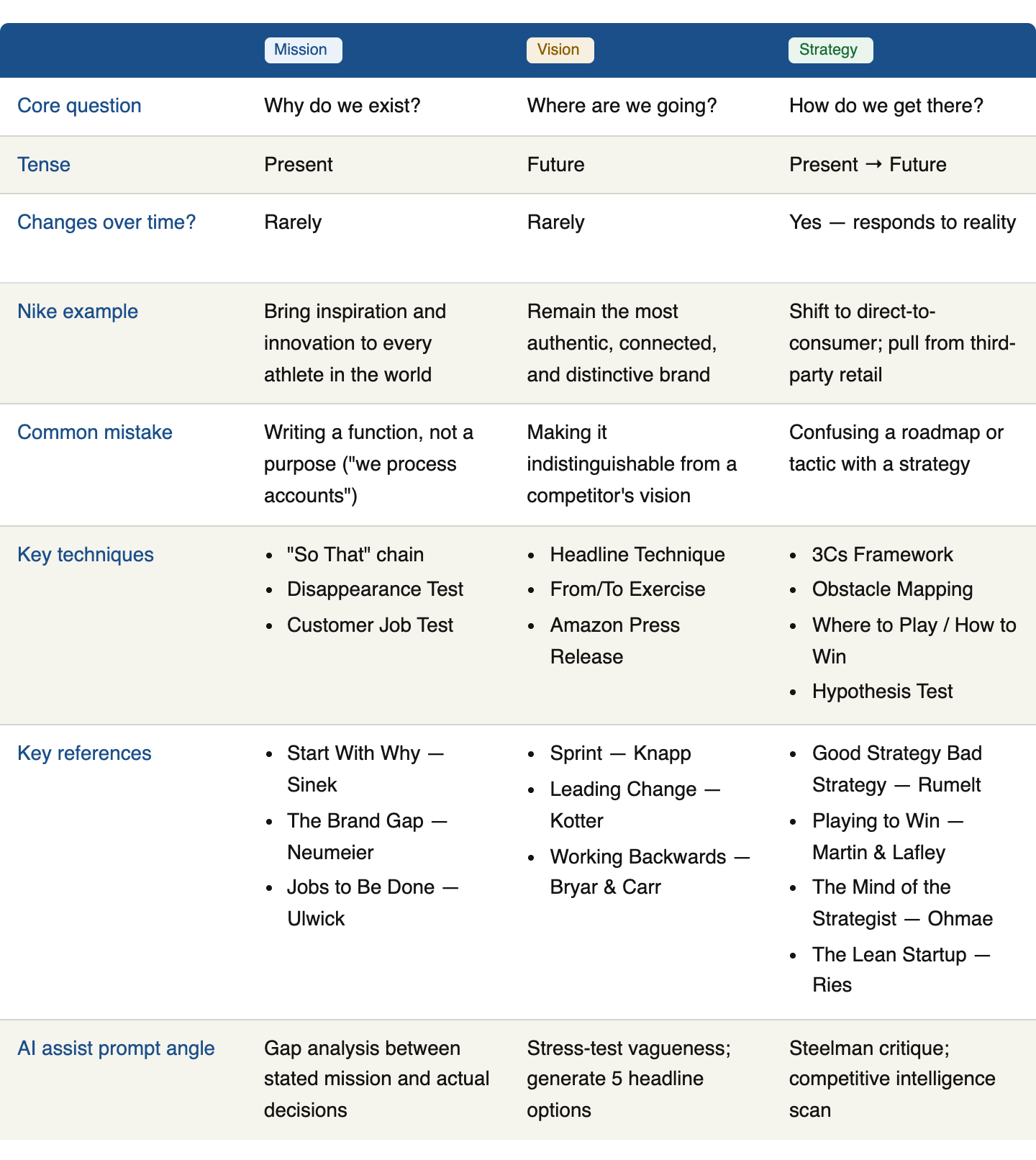
Quick Reference: Mission vs Vision vs Strategy
Use this table in your next planning session. Print it. Put it on the wall. Make everyone answer the same questions before the roadmap discussion starts.
Ready to Put This Into Practice?
This is exactly the kind of thinking we work through together. Not theory on slides. Real decisions, real tradeoffs, real product strategy practice with people who are building products at the same level you are.

